
The Complete Southeast Asia Backpacking Route: Bangkok to Bali in 6 Weeks
If you're mapping out a Southeast Asia backpacking route for the first time, start here. This is the classic overland trail — Bangkok to Bali — that thousands of backpackers have worn smooth over the years, and for good reason. It strings together five countries, a dozen unforgettable stops, and some of the cheapest travel days you'll ever spend, all in a loop that flows logically from north to south so you're rarely doubling back.
Six weeks is the sweet spot. It's enough time to slow down in the places that grab you (they will) without burning through your savings or your energy. Below is a week-by-week plan with daily budgets in USD, real transport options, and the border crossings that trip people up. Wittier travelers than us have called this the "banana pancake trail" — you'll understand why by week two.
One quick note before you book anything: timing matters more here than almost anywhere. The difference between arriving in dry season and monsoon season is the difference between beach paradise and a very wet backpack. Read our guide to the best time to visit Southeast Asia before you lock in dates.
Why the Bangkok-to-Bali Route Works
This particular Southeast Asia backpacking route is popular because the geography cooperates. You land in a major hub with cheap onward flights, move overland through countries with easy visa rules and dense bus networks, and finish on an island that's built for a proper wind-down. Costs stay low the whole way — most travelers spend $30 to $50 a day including accommodation, food, transport, and a few activities.
You can run it in either direction. We're going north-to-south (Bangkok to Bali) because the overland crossings from Thailand into Laos, Vietnam, and Cambodia are straightforward, and ending in Bali gives you a natural finish line with a big international airport for the flight home.
Before you go, sort these five things:
- Flights. Book a cheap one-way into Bangkok and leave the return open, or book Denpasar (Bali) to home once your dates firm up. Flexibility saves money.
- A regional eSIM. One data plan across all five countries means no SIM-card hunting at borders.
- Travel insurance. Scooter accidents and stomach bugs are the two most common claims on this route. Get covered.
- A backpack, not a suitcase. You'll be walking gravel lanes, boarding longtail boats, and climbing bus stairs. Aim for 40-50 litres.
- Copies of your passport. Digital and printed. Land borders and guesthouses ask for them constantly.
Week 1: Bangkok and Central Thailand
Bangkok (3-4 days) — Your gateway city and a full-body sensory experience. Base yourself around Sukhumvit for modern comforts or the backpacker classic of Khao San Road if you want to meet your travel tribe on night one. Hit the Grand Palace and Wat Pho early to beat the heat, eat your way through Chinatown after dark, and take a longtail boat through the canals. Book a half-day cooking class — it's the best $30 you'll spend all trip.
- Daily budget: $30-45 (hostel dorm $8-15, street food meals $2-4, temples and transport $10-15)
- Getting around: BTS Skytrain and MRT for the city, Grab (rideshare) for late nights
- Don't skip: A sunset rooftop bar — even a budget one — to see the sprawl light up
From Bangkok, most travelers push north. Grab an overnight train or a budget flight (AirAsia, Nok Air) to Chiang Mai. The overnight sleeper train is a rite of passage and saves you a night's accommodation.
For more on the city itself, see our Bangkok destination guide.
Week 2: Northern Thailand
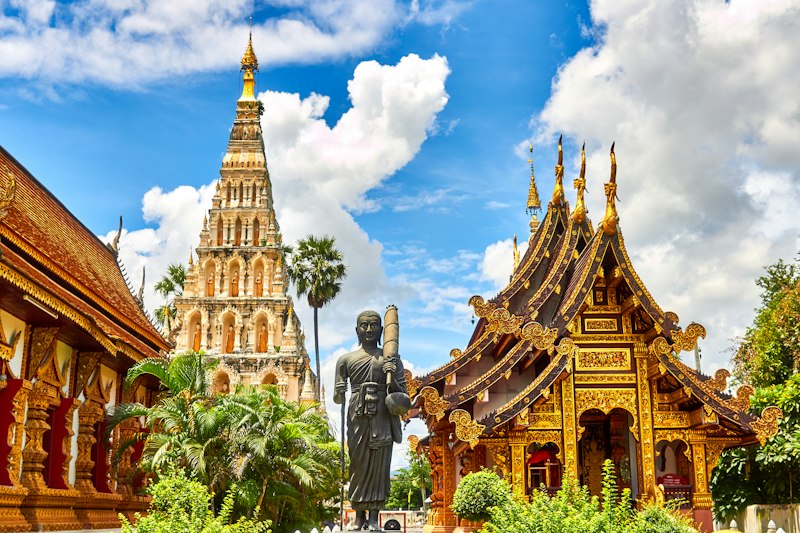
Chiang Mai (4 days) — The laid-back counterweight to Bangkok. Temple-hop through the Old City, wander the Sunday Walking Street market, and spend a morning at a genuinely ethical elephant sanctuary (look for "no riding" in the description). Ride a scooter up to Doi Suthep for the view. Chiang Mai is also the digital nomad capital of the region, so the cafés are excellent and the WiFi is fast.
Pai (2-3 days, optional) — A tiny mountain town three hours north via a famously twisty minibus (762 curves — motion sickness pills recommended). Hot springs, waterfalls, and hammock time.
- Daily budget: $28-40
- Transport: Minibuses from Chiang Mai's Arcade bus station; scooter rental $5-7/day
Week 3: Into Laos
Now for your first border crossing. From Chiang Mai, most backpackers head to the Thai border town of Chiang Khong, cross into Huay Xai, Laos, and take the famous two-day slow boat down the Mekong to Luang Prabang. It's a slow, scenic, beer-in-hand kind of journey. Border tip: Lao visa-on-arrival is available at this crossing — bring USD cash (around $35-42 depending on nationality) and a passport photo.
Luang Prabang (3-4 days) — A UNESCO-listed town of golden temples and French-colonial cafés. Watch the dawn alms ceremony (respectfully, from a distance), swim in the turquoise tiers of Kuang Si Falls, and catch the sunset from Mount Phousi.
Vang Vieng (2 days) — Once infamous for wild river tubing, now a mellower base for kayaking, lagoon-hopping, and hot-air balloon rides over the karst mountains.
- Daily budget: $25-35 (Laos is one of the cheapest legs)
- Transport: Slow boat, then buses or minivans between towns
Week 4: Vietnam
Cross from Laos into Vietnam, or — more commonly — fly from Luang Prabang or Vientiane to Hanoi to save a very long bus day. Border tip: Most nationalities now need to arrange a Vietnam e-visa online in advance (a few days' processing), so sort this before you leave Laos.
Hanoi (3 days) — Organized chaos in the best way. Get lost in the Old Quarter, master the art of crossing the road (walk slowly and predictably; the scooters flow around you), and drink egg coffee.
Ha Long Bay (2 days) — An overnight cruise through thousands of limestone islands. Book a mid-range operator; the cheapest boats cut corners on food and safety.
Hoi An (2-3 days) — Fly or take the train south to this lantern-lit tailoring town. Order a custom suit or dress, cycle out to the rice paddies, and eat the local cao lau noodles.
- Daily budget: $25-40
- Transport: The Reunification Express train is scenic; budget flights (VietJet) save time on long hops
Week 5: Cambodia
From Vietnam, cross overland into Cambodia — the Moc Bai/Bavet crossing near Ho Chi Minh City is the standard route if you've gone that far south, or fly Hanoi/HCMC to Siem Reap. Border tip: Cambodia offers e-visa online and visa-on-arrival ($30-36); at land borders, be firm about paying only the official fee and ignore "processing" upsells.
Siem Reap (3-4 days) — Home to Angkor Wat. Yes, the 4:30 AM sunrise wake-up is worth it. Buy a multi-day temple pass and pace yourself — the complex is enormous. Cool off afterward at the buzzing Pub Street and the night markets.
Phnom Penh (2 days, optional) — The capital delivers sobering, essential history at the Killing Fields and S-21, balanced by a lively riverfront.
- Daily budget: $25-35
- Transport: Buses (Giant Ibis is reliable) between cities; tuk-tuks for temples
Week 6: Indonesia and Bali
The grand finale. Fly from Siem Reap or Phnom Penh to Bali (usually via Kuala Lumpur or Bangkok on a budget carrier — AirAsia is your friend). Border tip: Indonesia charges a visa-on-arrival fee (around $35, payable by card at Denpasar airport) for most nationalities.
Bali (7 days) — The perfect place to decompress. Split your time:
- Ubud (2-3 days): Rice terraces, yoga, monkey forest, and jungle cafés
- Canggu (2 days): Surf breaks, beach clubs, and a strong digital-nomad scene
- Uluwatu (2 days): Clifftop temples, sunset fire dances, and world-class waves
Finish with a sunset at Tanah Lot, raise a Bintang, and toast six weeks well spent. For the full lowdown, see our Bali destination guide.
- Daily budget: $35-50 (Bali runs a touch higher than the mainland)
- Transport: Scooter rental $5-8/day, Grab and Gojek in the south
Total Budget for the Route
Here's the honest math for six weeks (42 days), excluding your international flights in and out:
| Country | Days | Daily budget | Subtotal | |---------|------|-------------|----------| | Thailand | 12 | $30-45 | $360-540 | | Laos | 6 | $25-35 | $150-210 | | Vietnam | 8 | $25-40 | $200-320 | | Cambodia | 6 | $25-35 | $150-210 | | Indonesia (Bali) | 7 | $35-50 | $245-350 |
That's roughly $1,100-1,600 on the ground for the whole trip, plus regional flights ($150-300 total for the two or three you'll need) and your international airfare. Backpacking Southeast Asia really is that affordable. If you want to stretch every dollar even further, our guide to budget travel that lets you see the world has tricks that apply to this whole route.
Doing it alone? Don't overthink it — this trail is the most social route on earth, and our solo travel guide for 2026 covers how to meet people and stay safe from Bangkok to Bali.
Essential Tips for the Whole Route
- Get a regional eSIM. One data plan that works across all five countries beats hunting for SIM cards at every border.
- Carry USD cash for visas. Land crossings often want clean, un-torn dollar bills. Stash a few $20s and $1s.
- Book the first hostel of each country in advance. After that, wing it — beds are plentiful and often cheaper booked in person.
- Travel insurance is non-negotiable. Scooter spills and stomach bugs happen. Get covered.
- Check entry rules before every crossing. Visa policies shift; verify on official sources. Thailand's official tourism board and each country's immigration site are the sources of truth.
- Learn "hello" and "thank you" in each language. It's the cheapest goodwill you'll ever buy.
How to Customize the Route
Six weeks and five countries is the default, but this trail bends easily. A few common variations:
- Short on time (3-4 weeks)? Cut Laos and pick two countries plus Bali — Thailand and Vietnam finishing in Bali is a strong, fast version.
- Beach person? Add a week in the Thai islands or the Gili Islands off Lombok, and trim a city or two.
- History and culture over parties? Give Cambodia and Vietnam extra days and lean into the temples, museums, and old towns.
- Digital nomad? Base longer in Chiang Mai, Canggu, or Da Nang, where the WiFi and café scenes are built for remote work.
The overland spine stays the same — you're just deciding where to slow down. Because the route runs on cheap buses, budget flights, and flexible guesthouses, you can adjust on the fly once you're moving.
A Few Words on Staying Healthy and Safe
Nothing here should scare you off — Southeast Asia is one of the friendliest, most traveled regions on earth. But a little prep goes a long way:
- Eat at busy stalls. High turnover means fresh food. The safest street food is often the most popular.
- Drink bottled or filtered water and skip ice in very rural spots if you're unsure.
- Wear a helmet on scooters, even for short rides. It's the single biggest safety factor on this trip.
- Keep valuables minimal and close. A crossbody bag beats a back pocket in crowded markets.
- Save your embassy and local emergency numbers offline for each country.
Ready to Map Your Own Route?
The beauty of this Southeast Asia backpacking route is how easily it bends to fit you — add islands in Thailand, skip Laos for extra beach time, or stretch Vietnam into two weeks. There's no wrong version.
Want a personalized plan with live flight prices, day-by-day timing, and hidden gems along the way? Start planning with Atlas — tell it your dates and budget, and it'll build your route in a single conversation. Your Bangkok-to-Bali adventure is one chat away.